



Beer Marketer's Insights
In administration that includes several cabinet members with long history of criticizing fundamental roles of agencies they lead, Food & Drug Administration commissioner Scott Gottlieb was an anomaly even tho he at first seemed to be cut from same cloth: he proved continually outspoken in putting consumer safety first in booming new sectors like vaping and CBD that have been receiving heavy investments from major corporate interests – taking the punch bowl away just as the party was getting good, to use phrase once used by Alan Greenspan to describe financial role of Federal Reserve. That led quite a few of our contacts to wonder how long his run would last, and answer came yesterday: he’s departing agency in a month in order to spend more time with his family up in Conn. As NY Times wrote, “his announcement caught many in Washington and the industries he regulates by surprise and raised questions about whether his push to reduce teenage vaping and lower nicotine levels and ban menthol in cigarettes will continue in an administration that generally has a hands-off approach to business.” Or more pertinently to many in bev biz, his push to rein in explosion of CBD-based items on grounds that too little is known about how safe they are, a product in part of severe restrictions on research going back decades because of the plant’s recently repealed Schedule 1 status. As cannabis letter Leafly put it, Gottlieb’s presence mattered because he has made CBD, along with nicotine vaping and opioid abuse, one of his high-priority issues.” So at time industry was still celebrating passage of Farm Bill that seemed to remove key hurdle from CBD buildout, his agents were going around busting Dirty Lemon copackers and raiding smoke shops, as we’ve been reporting. More recently, he assured congressional panel that he’s “deeply focused” on getting that segment figured out, perhaps thru a legislative fix rather than more protracted rulemaking, but now it will be someone else’s job to do so.
Gottlieb’s activist stance – heralded in constant flow of blogs, emails and statements – was particularly surprising given his background as venture capitalist and anti-regulatory zealot. As former FDA asst commissioner Joshua Sharfstein told Times, “He surprised a lot of people in his willingness to take some risks for public health.” Cannabis newsletter Leafly cited range of public health experts and activists who “took the news of Gottlieb’s departure hard, in part because the former physician and venture capitalist has been considered one of the most competent Trump appointees.” But he was also criticized for too tepid approach to opioid crisis. Tho some libertarians and conservatives had been complaining that he was indulging in “regulatory panic,” Washington Post noted, sources insisted he wasn’t pushed out by Trump, who tweeted approval of his role and even hinted there might be another role in the offing for him.
Blurring strategies of alc and non-alc giants has claimed a high-profile casualty: Olivier Goudet, who said he won’t stand for reelection to Anheuser-Busch InBev chmn next month because his role at controlling Keurig Dr Pepper investor JAB poses too great a conflict of interest these days. That means he’ll exit a year before end of his 5-yr term, as Financial Times first reported, citing source who said, “last year’s JAB acquisition of Keurig Dr Pepper, the coffee and fizzy drinks maker, had raised concerns on the brewer’s board that its holdings had become too close to those of AB InBev,” which is now aggressively looking beyond beer to boost its portfolio including via diverse NA mix. For its part, JAB has been on “$50 billion+ dealmaking spree” in recent yrs, including bevs, as FT reminded. Olivier said only that he’ll spend more time running JAB, and ABI said “the board’s succession plan has been developed since last year and we have been working with Mr. Goudet on a smooth transition.” His successor and new members come aboard next mo. Goudet has been chmn since 2015, preceded by another JAB mgg partner, Peter Harf.
To Brett Cooper at Consumer Edge Research, ABI’s presence at Pepsi bottler in Latin America was minor issue, but “the problem is evident in ABI’s appointment of a head of non-alcoholic beverages last year and their push in non-alcoholic beverages in North America. We have thought and continue to believe that ABI will look to (1) build distribution relationships with smaller players – ultimately take those businesses in house akin to KDP’s Allied Brand business, (2) make acquisitions in non-alcoholic beverages and (3) innovate in non-alcoholic beverages.” No surprise there. Indeed, we've already seen all of them in play. But Brett goes further on KDP side: “We don’t think that KDP stops at non-alcoholic beverages. One of the arguments that KDP made at the outset of the DPS acquisition was that coffee was a beverage. We think that there is work to be done to better manage the DPS business. We think that improving the operations of the former DPS business has years of upside in terms of performance. However, we ultimately believe that the evolution of retail and the consumer will have KDP looking to go beyond non-alcoholic beverages into alcohol. After all, if coffee is a beverage, then so are FMBs and canned cocktails (for a company that is already in the mixer business). If this proves out to be true, it puts ABI and KDP (controlled by JAB) in competition even more than they are in non-alcoholic beverages.” There could also be an issue as KDP team potentially rethinks co’s distribution strategy, he believes.
CSD volume decline accelerated to -3.8% but avg prices were up solid 5.3% last 4 wks thru Feb 23 in Nielsen all-channel data reported by Wells Fargo Securities’ Bonnie Herzog. Coca-Cola volume was off 1.3% (down from -0.6% for 12 wks) on avg price increase of 4.1% last 4 wks. KO’s diet brands were off just 0.2% while full-calorie dipped 1.9%. Volume for Coke and Diet Coke were up 2.3% and 1.2% respectively while Coke Zero gained 7.6% and Sprite Zero was up 6.6% for 4 wks. PepsiCo CSD volume decline worsened to -6.6% (vs -4.8% for 12 wks) despite avg price decrease of 5.4% last 4 wks. Volume on its full-calorie brands fell 8.7% vs -1% for low-cal brands. Pepsi Max decelerated a bit but still up double-digits (+12.7%) for 4 wks. Diet Pepsi volume was flat while brand Pepsi was down 3.7% for 4 wks. Mountain Dew fell 3.5% and Diet Dew -2.4%. Keurig Dr Pepper CSD volume decline more than doubled to -4.5% but avg prices were still up solid 7.5% last 4 wks in all-channel. Dr Pepper volume was up 2.7% while 7 Up dropped 8.5% last 4 wks. Private-label CSDs were off 3.4% on avg price increase of 2.3% for 4 wks.
Monster Volume Down as Price Hikes Hold; Bang Grabbin’ Share Energy drink volume slowed from 7.3% gain for 12 wks to +4.6% latest 4 wks on avg price increase of 4.7% in all-channel data. Monster ceo Rodney Sacks made it clear during quarterly call last week that co wasn’t backing off price hikes and remains confident in strategy regardless of what Red Bull does (BBI, Feb 28). Monster avg price increase eased a bit last 4 wks with 6.4% gain and volume fell 3.4%. Java Monster still hot, up 16.8%, as it continues its surge since recovering from production shortages, while core Monster up 2.5%, no-sugar Zero Ultra up 8.3% for 4 wks. Monster Rehab slowed its decline to -5.6% last 4 wks. And its Hydro brand, after restage into conventional PET bottles from plastic cans, continues to come on strong, +145.3% for 4 wks, 204.3% for 52 wks, to point where it’s $140 mil brand at retail.
Red Bull volume increased 9.1% on small avg price drop of 1% last 4 wks. Original Red Bull brand volume was up 7.2% while The Blue Edition jumped 15% on slight (-0.7%) price decrease for 4 wks. Bang Energy still on a big roll with volume soaring 852% even with avg price hike of 7.1% last 4 wks. Bang is up to 6.8 share of dollars, passing Rockstar at 6.5, while Monster down around 0.8 share to 42.5 and Red Bull up a tick to 35.9 share last 4 wks. Data indicates Bang is $370 mil brand at retail over past 52 wks. Rockstar volume was down 10.9% with avg price gain of 3.7% last 4 wks. PepsiCo energy brands plummeted 28.6% (vs -21.8% for 12 wks) with avg price increase of 2.4% last 4 wks. Mtn Dew Kickstart still struggling, off 13% last 4 wks.
Private-Label Up while Top Water Suppliers Slip Bottled water volume gain slowed to +1.9% (vs +3.4% for 12 wks) even as avg prices increase was at modest +0.6% last 4 wks. Nestle, Coca-Cola and PepsiCo each lost volume while private-label waters gained 12.7% on avg price discount of 1.2% last 4 wks. Nestle volume was down 10.9% on solid avg price increase of 7.6% last 4 wks. Poland Spring volume was up 1.3% while Nestle Pure Life dropped 15.4% with 7.2% price increase last 4 wks. KO water volume was off 4.1% on small avg price gain of 0.7% last 4 wks. Dasani volume was off 1.5% with 1.1% price increase. PEP water volume slipped from 2.7% gain for 12 wks to -0.9% last 4 wks with avg price increase of 3%. Aquafina was up 1.4% on flat prices last 4 wks.
LaCroix Struggles as Sparkling Ice, Polar, Poland Spring up Double-Digits in Sparkling Sparkling flavored water slowed a bit last 4 wks but volume still up strong 13% even with avg price increase of 3.6% in all-channel stores. Talking Rain Bev (Sparkling Ice) remained hot: volume up 20.3% on small avg discount of -1.7% last 4 wks. Sparkling Ice volume gain accelerated to 29.4% last 4 wks with lift from 5.7% price drop. National Bev, which enjoyed dramatic growth for long stretch in flavored water category with its La Croix brand, is now down significantly. Volume off 10.6% for 4 wks, -6.1% for 12 wks while still up 16.4% for 52 wks. La Croix volume down 6.6% with avg rice increase of 5.6% last 4 wks. PepsiCo, heavily backing La Croix challenger Bubly, saw its sparkling water/seltzer boom by over 1,000% for 4 wks, 550.3% for 52 wks, to point where it’s $130 mil biz. Nestle volume up 7% with avg price gain of 3.7% last 4 wks. Flavored Poland Spring jumped 23.6% with 5.8% price increase last 4 wks, very similar to its 12-wk trend. Polar Corp posted a solid 12.7% volume gain with avg price increase of 3.6% last 4 wks. Coca-Cola flavored waters declined 10% with hefty 12% price hike, while KDP dipped 0.8% with 2% price cut last 4 wks.
Body Armor Keeps Rolling Sports drink volume drop worsened last 4 wks (-4.5% vs -1.4% for 12 wks) while avg price increase only changed slightly, up 4.3%, in Nielsen data reported by Morgan Stanley’s Dara Mohsenian. PEP’s Gatorade volume dropped 8.1% (down from -4.8% for 12 wks) with avg price increase of 2%. Gatorade off 0.7% for 52 wks in all-channel stores. KO’s Powerade was off 3.9% with 1.2% avg price increase last 4 wks. Up just 0.9% for 52 wks. Then there’s its new KO sibling Body Armor. Winter or not, its volume shot up 107.3% with 3.2% price drop last 4 wks. Body Armor up 118% for 52 wks.
Odds & Ends: PEP’s Tea Biz Slips, KO Struggles in Coconut Water, KDP Negligible in Energy PEP’s once-surging iced tea biz has flattened out considerably, declining 4.3% in latest period, -1.5% for 52 wks, with annual tally of $1.58 bil . . . KO continues to struggle in coconut water in measured channels, with unit volume skidding 33.25% for 4 wks, 27.2% for 12 wks, 20.4% for 52 wks, to point where it’s just $40 mil biz or so . . . Meanwhile, KDP saw negligible energy drink biz built around Venom relatively flat at just $30 mil or so in sales tho keep in mind it’s mustering increasingly broad range of RTD coffees and coffee shots that might also win some of those occasions.
Tho coconut water as a category may be plateauing in recent years, it continues to draw high-end players, including pair we’re profiling here. New entry at high end called Taja Coconut is claiming to be first all-natural, cold-filtered brand, offering raw, clean and pure taste, in words of founder Nilang Patel. LA-based brand is going out initially into Midwest markets at $3.49-3.99 per 10-oz clear PET bottle, as well as online. Co claims to have patented a cold-filtered, 3-part process that extracts coconut water while keeping all nutrients intact without the intrusion of heat, air or additives, using coconuts that are processed within 48 hrs of being picked. The empty shells are ground into compost used to grow more trees. Info at TajaCoconut.com . . . Meanwhile, an organic brand called Eliya that’s attempting to play at luxury end using Sri Lanka’s King coconut variety packed in elegant 10-oz glass bottle (BBI, Jul 8) has embarked on $2 mil capital raise for use in building inventory, hiring seasoned sales chief and bringing aboard marketing team. NY-based co, founded by Wall Street vets Abhijit Kukreja and Fariq Merchant has been avidly plying corporate accounts like UBS, Citi Group, NY Times and Ford Foundation as well as hotels and resorts like Fairmont, Royalton, Jumeirah and Caesars Palace. Among its 500+ retailers in Northeast are NY-area chains like Foodtown, Shop Rite, Key Food and Westside Market, along with HEB in Texas. It just signed broadline distributors UNFI and KeHe and enlisted Cascadia Managing Brands of Ramsey, NJ, to plot buildout. Eliya will be exhibiting at upcoming Natural Products Expo West. Info at EliyaNYC.com.
After earlier retreat, Roar Organic is building up impressive head of steam on recruitment front, most recently by bringing aboard Glaceau and Core Nutrition vet Eric Berniker as cmo (BBI, Feb 28). After enjoying presumably exit from Core after KDP’s recent acquisition, Eric is joining revamped mgmt team capped by recently recruited prexy/coo Bart Silvestro, a vet of Chef’s Cut Real Jerky and Popcorn Indiana who’s serving as righthand man to founder/ceo Roly Nesi. Discussing his move to Huntington, NY, co on Fri, Berniker indicated that twists and turns in its development since 2012 founding have left brand in good spot as something more than a narrowly focused sports drink but rather an electrolyte infusion suited to broad array of millennials’ usage occasions. He noted that, within a week of his Core exit, Roar was suggested to him as logical next stop by broad array of retailers, Whole Foods types and “beverage nerds.”
As Berniker recounted it, Roar was created by Nesi as cleaner sports drink than Gatorade with in-your-face flavor names like Mayhem Punch and Cosmic Grape that each got different graphic treatment. Along way, tho, pop culture aficionado Nesi saw emergence of athleisure trend, with brands like lululemon crossing over to broad appeal as empowerment icons. That pointed to potentially underserved market in bevs and in 2017 he broadened brand to its current position as certified-organic “electrolyte infusion” that contains not just electrolytes but also antioxidants and vitamins, with only 2 g of sugar (10 calories) per serving. Berniker sees it as geared toward what he likes to call the “multidimensional millennial,” filling role beyond workout occasion that’s also often served by juices and coconut waters. The more sophisticated label graphics the brand currently displays are subtle patterns inspired by athleisurewear. (Pivot away from narrow sports drink category also means Berniker won’t be competing directly vs his old boss at Glaceau, Mike Repole, who’s running Body Armor – a good thing, Eric laughed.) As brand has found its way, the financial support has come, with AccelFood leading a $5.6 mil capital round that supported the hiring of Silvestro, Berniker and a new cfo.
From Eric’s perspective, Roar brand name is still relevant, this time in empowerment sense of “make moves and be heard” that should strike chord with younger consumers looking to have an impact in their careers. With that in mind, brand’s Expo West booth this week will be offering free professional portrait shots and giving away portable phone chargers. Berniker will be building out his marketing team in coming months. Key focuses in near future will be such “culture markets” as NY, LA and SF.
So far, brand footprint has been narrow, including some influential retailers like HEB, Mariano’s and Wegmans, where Roar quickly grabbed #3 spot in advanced hydration section. Roar also is working corporate accounts like Facebook and LinkedIn, where brand can move 7-10K bottles per week. It just landed Just Salad chain and immediately grabbed 10% of bev sales there, including fountain. An Albertsons push is coming soon. Brand’s DSD footprint likewise remains very tight, with Dora’s Naturals working brand in core NYC market but few others in mix. All that will be patiently built out, Eric promised.
Nutrabolt continues to make headway building out a DSD map for its C4 performance energy brand, recruiting Calif houses Coast (SoCal), DBI (NorCal) and Valleywide (Central Valley) to augment its presence in Haralambos Beverage around LA. The co also has begun to fill in some heartland territories, including enlisting Kimball in North Texas to work c-store operations there, and it hopes to be ready to announce its first DSD partners on East Coast in coming weeks, said evp/gm John Herman. C4, recall, offers an alternative to VPX’ explosively growing Bang Energy to indie DSD players who either haven’t been able to land Bang or might be spooked by its growing list of legal challenges, including a suit over intellectual property by Thermolife, whose patents are licensed by C4. The progress comes as Herman reports that C4’s best sku’s are proving to offer velocities matching those of Bang in some accounts and outpacing Rockstar, per Nielsen data he cited. Brand awareness has been building in Southern Calif, where brand has been deploying street teams since last summer, offering encouragement to expansion of effort in coming year (BBI, Oct 29). And chain authorizations are beginning to roll in, at least at regional level, including c-store outfits like 7-Eleven, Chevron, Quick Trip and Sheetz, and grocers like Bristol Farms and Gelson’s. C4 currently is being shipped chainwide to Sprout’s Farmers Market chain, John indicated . . . Right on Brands said its hemp-based Endo brand is being picked up for distribution by Bud house Double Eagle Distribution of Deerfield Beach, Fla, for that house’s Broward and Palm Beach Counties footprint. Endo-branded offerings include 9.5 pH, oxygenated Endo Water. Double Eagle joins distributor roster that includes Oklahoma unit of wine & spirits giant Republic National Distributing Co, along with Belle Pointe Distributors in Fort Smith, Ark, Bud house McBride Distribution in Fayetteville, Ark, Lipari Foods in Warren, Mich, SDK Distribution in Seattle and Texas Select Beverage as master distributor in that state.
Bud and Miller may be feuding over corn in beer, but the non-alc realm now can boast its own grudge match, albeit at much lower media budget. Reed’s Inc and Keurig Dr Pepper lawyers have exchanged letters over social media campaign that ginger brew maker Reed’s launched heralding class-action suit Canada Dry recently settled over what judge concluded were unfounded claims that ginger ale leader employs meaningful enough amount of ginger to support slogan that it’s “Made from Real Ginger.”
As reported recently (BBI, Feb 27), Reed’s has concluded that legal setback suffered by Canada Dry offers opening to herald its own ginger-intense recipes via social media campaign that offers consumers exhortations such as “Up your game with Reed’s Ginger Beer,” “Time to get real and try Reed’s” and “Reed’s is made from real ginger.” Turns out effort drew cease-&-desist letter dated Feb 22 from KDP vp/asst general counsel Amy Brosius, who takes issue with ads that “disparage our Canada Dry products, by portraying the products tipped over on their sides and/or crushed. Reeds has also gone so far as to alter the genuine Canada Dry trade dress by changing the words on the front label of the Canada Dry containers portrayed in the ads from ‘Ginger Ale’ to ‘Ginger Fail.’” In the letter the attorney demands that Reed’s drop the ads in 3 days and substantiate its statements that Reed’s has 1,000X more ginger than Canada Dry, among other demands. Response 4 days later from Reed’s counsel at Libertas Law Group cites constitutional protections for comparative advertising, and notes that Reed’s least-strong ginger brew contains 6,000 ppm of real ginger compared to what experts in court case found to be 2 ppm in Canada Dry. As for substantiating where Reed’s got notion that Canada Dry has dropped longstanding slogan, another demand contained in KDP letter, Reed’s attorney notes that that’s what Canada Dry marketer agreed to do in settling suit. Game on!
PepsiCo’s new ceo, Ramon Laguarta, has reshuffled leadership team, creating new role of global chief commercial officer for Laxman Narasimhan, a McKinsey & Co vet who’s been running Latin America and Europe & Sub-Saharan Africa (ESSA) regional units. In new role, he’ll oversee PepsiCo's Global Category Groups, Insights, Commercialization, Design, Global R&D, E-Commerce and Strategy units. Silviu Popovici, point man on ESSA, now steps up to ceo role that Laxman is leaving. He continues to run LatAm until a successor is determined there. Key to appointment is move to “delayer” co, with all leaders of key biz units now reporting directly to Narasimhan. They include several execs with ceo titles: Kirk Tanner (PepsiCo Beverages North America), Vivek Sankaran (Frito Lay North America), Silviu Popovici (Europe Sub-Saharan Africa), Mike Spanos (Asia, Middle East, North Africa) and whoever will take over LatAm duties, as well as Jim Andrew, evp for Soda Stream and Beyond Bottle Ventures. As part of changes, Dr Mehmood Khan, vice chmn and chief scientific officer for global R&D, will retire from PepsiCo this month, succeeded by Rene Lammers, currently svp of category R&D, who also will report to Narasimhan . . . Nestle Waters North America has recruited General Motors vet David Tulauskas as vp and chief sustainability officer, succeeding Nelson Switzer, who left NWNA last year to join co’s corporate partner in plastic sustainability, Loop Industries.
Aiming for ubiquity suited to soda replacement on both distribution and retail fronts, Revive Kombucha has launched shelf-stable canned sparkling line that seems to offer functional gut-health twist on La Croix at scarce expenditure of 20 calories from consumers’ calorie budgets. Petaluma, Calif-based co recently tested Revive Sparkling Kombucha at handful of Northern Calif retailers like Oliver’s Markets and online at GoodEggs.com, but will formally kick it off at Natural Products Expo West this week in Anaheim, Calif. New line employs Deerland’s DE111 live probiotic that can withstand rigors of pasteurization process until being activated in drinker’s gut. The 12-oz conventional cans are claimed to contain 5 bil live probiotics at time they’re produced, but only 5 g of sugar for 20 calories per can. Sweetness is derived from cane sugar and fruit purees. The line debuts in black-tea-based Mango Orange, yerba-mate-based Strawberry Lemon, and the caffeine-free Cherry Hibiscus and Citrus Ginger flavors, all different than kombucha renditions available in Revive’s core glass bottles and kegs. New brand will go out to retail in single cans priced at $2.99, tho GoodEggs.com also has been offering 4-pks at $11.99.
Revive cofounder Sean Lovett told BBI yesterday that Revive Sparkling Kombucha is intended to take Revive back to its core priority, to “kick soda’s butt,” as it did in his own consumption habits before he started brewing his own. Playing with possible themes, his marketing vp Josh Mohr added that Sparkling aims “to start a revolution of refreshment.” Accomplishing those aims require tackling 3 challenges: broadening usage occasions via can format, offering more refreshment-oriented liquid that offers gut-health benefit at cost of very few calories, and broadening route-to-market options beyond the limited range of refrigerated-distribution channels. Latter in turn suggests broad push into beer and Snapple distributors along lines that rival Brew Dr has pursued with its nominally refrigerated line, tho Lovett said he’s still mapping out plan. Recall that co last year retreated from East Coast push that proved overly ambitious. In its core Calif market, Revive gets to retail aboard captive refrigerated DSD operation of Peet’s Coffee, which holds controlling stake in co. Asked what shelf life is, Sean said co is still in pilot mode, deciding what timeframe to state.
Kombucha brewers prefer to stay vague about their brewing processes and Revive is no exception. Sparkling represents first project undertaken by Sean and Mohr at time of new recruit’s arrivals 9 months ago, after long runs at Red Bull and then Muscle Milk marketer CytoSport. Developing shelf-stable line required intensive internal R&D that included developing process, then building and installing equipment, thru “countless evenings for months on end, batch on batch,” as Lovett put it. The packaging process likewise is proprietary. That said, by declaring line to be shelf-stable, Revive is continuing its commitment to “transparency and truth in labeling,” Lovett declared.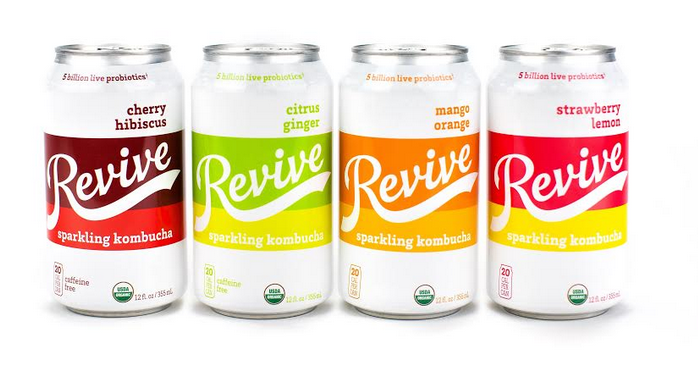
Fiber-intensive Hellowater brand has landed some key retail partners as it heads into new year, starting with breakthru at Walmart. Founders Tom Bushkie and Rusty Jones said Fri that mass merch giant has agreed to take Smile (Mixed Berry) and Dance (Orange Mango) flavors of core 16-oz line into 2,100 stores this April, while picking up 8-oz multipack for 800 of the same and different stores. In doing so, Walmart is eschewing newly launched 8-oz kids line in favor of more neutrally branded version that doesn't trample kids’ aspirations to drink what the bigger kids drink or alienate moms who’d just prefer a smaller-size bottle.