



Beer Marketer's Insights
As alcohol businesses, drinkers and (some) governments across the globe seeks changes to make getting a drink a bit easier during the pandemic, public health advocates continue to gear up to reverse course. A just-released report from UK's Commission on Alcohol Harm sees that harm "everywhere," drinking and drinking-related problems growing during the pandemic and an opportunity for the UK government to adopt a strategy to reduce harm via changing policy and altering the "conversation and culture around alcohol." Specifically, the Commission wants UK to follow the WHO's preferred strategy and "evidence- based recommendations" to raise prices, reduce availability, end industry sponsorships and more. Equally important, the Commission urges the government to "change the conversation and challenge alcohol's position in our culture." Instead of focusing on "weak or irresponsible" individuals and asking adults to "drink responsibly," government should "put the responsibility squarely with the harmful product itself."
Just as the extensive Monitoring the Future and Youth Risk Behavioral System surveys indicated a slowdown or pause in the decades-long decline in teen drinking rates, so does the recently released National Survey on Drug Use and Health (NSDUH) from the federal government. The table below shows drinking rates among younger teens, age 12-17, comparing rates for 2008, 2018 and 2019. After falling sharply over the 2008-2018 period, rates of current drinking (past month), binge drinking (5+ drinks on at least one occasion in past month) and heavy drinking (at least 5 binges over the previous 30 days) stalled or reversed in 2019. 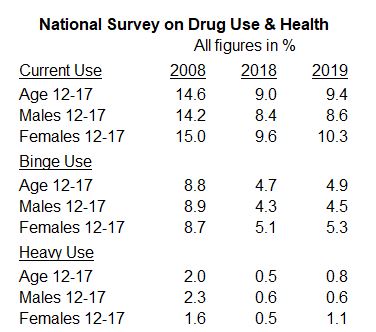
Long-time readers of Alcohol Issues INSIGHTS will recall that for many years, public health advocates, government officials and the media wrung their respective hands over the "epidemic" of underage drinking. That language/coverage/concern faded considerably as youth drinking rates plummeted (without adopting virtually any of the broad environmental measures that the former so urgently pressed), as measured by the YRBS and MTF surveys noted above. A new crisis involving young people emerged in recent weeks as media coverage exploded over a sharp increase in coronavirus cases on numerous college campuses as they re-opened. Not too surprisingly, many students apparently quickly reneged on pledges to mask, socially distance, not gather in large groups and not party. Here's just a taste of the media coverage:
- University of Alabama President Stuart Bell called for action to ensure a safe re-opening. "Tuscaloosa Mayor Walt Maddox took him up on that call, announcing an executive order closing bars and bar service through September 8. 'In the fight against Covid-19, it's been the bars and restaurants that have taken the disproportionate impact,' Maddox said." The Mayor also requested that the state ABC "place all of Tuscaloosa County under a prohibition on all alcohol sales for on-premise consumption at bars and restaurants from Aug-24-Sept 8." Station WVUA 23 (Editor's Query: how often and in how many places will the word "prohibition" replace the word "essential" going forward?)
- The University of Iowa announced that in the first week on campus testing revealed 130 cases among 957 individuals tested, a positivity rate of 13.6%, compared to 8.8% before classes resumed. "After crowds of maskless University of Iowa students were seen mingling shoulder-to-shoulder in Iowa City bars over the weekend," UI president Bruce Harreld wrote an "open letter" to Iowa City bars/restaurants "slammed the establishments for sluggish enforcement and scolded them for a recent spike in virus cases," and "imploring" them to follow the Governor's guidelines requiring social distancing.
Sharp drop-offs in teen drinking rates across the board could not continue forever. Or perhaps the trend is simply taking a pause. The federal government's Youth Risk Behavior Survey shows that 29.2% of high schoolers met the definition of "current alcohol users" in 2019 (at least once in prior 30 days), an insignificant dip from 29.8% in 2017. The 2017 rate was a full 3-point decline from 2015, and down from 41.8% over the last decade. So, the YRBS shows a similar 30% decline in current use over 10 years as the annual Monitoring the Future Surveys. The MTF surveys for 2019 showed more significant declines vs 2017 than the YRBS, but modest changes vs 2018. Meanwhile, despite legalization, marijuana use, as measured by YRBS, changed little in either the short run (up 10% since 2017 but the same as in 2015) or the longer run (+4% vs 2009). Perhaps access/availability don't actually impact youth use of marijuana very much either.
While "Just Say No" has traditionally been the widely-accepted mantra for those fighting substance abuse problems, a review of treatment and recovery programs across the world found there to also be acceptance of "non-abstinence as an outcome goal" over the past 40 years. Interestingly, however, the authors could not determine whether such acceptance has increased, decreased or remained stable over time. Researchers analyzed 25 articles published from 1981-2019 that reported on "agency and/or clinician acceptance of non-abstinence treatment goals." They found more acceptance of non-abstinence or controlled use "as an outcome goal": 1) for those "less severely impaired rather than for more severely impaired clients"; 2) when used as "an intermediate goal" on the way to abstinence rather the final outcome goal; 3) for those dealing with alcohol or cannabis abuse rather than drugs such as cocaine, heroin, opioids, meth, etc. The review of treatment programs also found there was wider acceptance of non-abstinence goals for those in outpatient programs compared to those in residential settings, possibly an indication of the severity of patient problems. Also, this analysis found "larger proportions of service providers" across many European countries, as well as Australia, were more open to "endorsing non-abstinence goals than those working in the United States and Canada."
Spirits Tax Levels Not (Even) Closely Linked to "Alcohol Attributable Death" Rates Either
The June edition of Alcohol Issues INSIGHTS questioned the oft-cited link between alcohol taxes/pricing, specifically state spirits taxes, and consumption rates. States with high relative spirits taxes are not necessarily among those with the lowest per capita alcohol consumption. And states with lower than average spirits taxes are not necessarily among those with the higher per capita consumption. Subsequently, the Centers for Disease Control published new data on state by state "age-adjusted alcohol-attributable deaths" from 2011-2015. That gave us a chance to explore the similarly popular mantra that there is a direct link between alcohol taxes and alcohol problems, specifically state-by-state alcohol-related deaths. And? There's a tenuous relationship at best, certainly no definitive or linear association. The table below ranks states by the highest and lowest spirits tax per gallon rates, along with their age-adjusted alcohol-attributable deaths per 100,000 population. The US AAAD figure is 27.4. 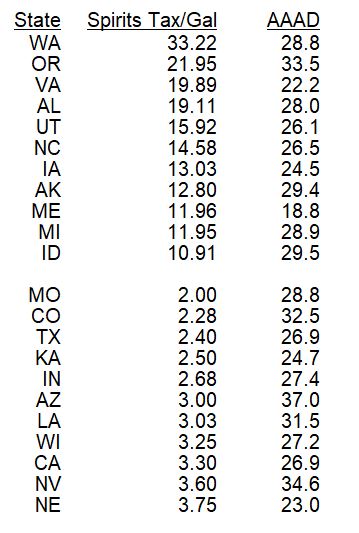
In recent years, public health advocates had very little success in changing specific alcohol policies in the US. Indeed, federal excise taxes were reduced in 2017. Availability and access mostly expanded. Earlier this year, most government entities deemed the alcohol beverage industry "essential" amid the coronavirus pandemic. Many regulations were relaxed in many states, especially regarding cocktails-to-go and delivery. But public health advocates are on the verge of a significant victory as the Dietary Guidelines Advisory Committee recently adopted a scientific report which recommends a major change in the Dietary Guidelines for Americans. The proposal reduces the recommended upper limit for men who drink to one per day, matching the upper limit for women and halving what had been the limit for men since 1990. Department of Agriculture and Health and Human Services officials will spend the rest of year drafting a final policy document, the 2020-2025 US Dietary Guidelines, slated for release by the end of 2020, though the process could stretch into 2021. Interested parties will continue to lobby for and against the recommended change.
Long-time readers of Alcohol Issues INSIGHTS will recall that for many years, public health advocates, government officials and the media wrung their respective hands over the "epidemic" of underage drinking. That language/coverage/concern faded considerably as youth drinking rates plummeted (without adopting virtually any of the broad environmental measures that the former so urgently pressed), as measured by the YRBS and MTF surveys noted above. A new crisis involving young people emerged in recent weeks as media coverage exploded over a sharp increase in coronavirus cases on numerous college campuses as they re-opened. Not too surprisingly, many students apparently quickly reneged on pledges to mask, socially distance, not gather in large groups and not party. Here's just a taste of the media coverage:
- University of Alabama President Stuart Bell called for action to ensure a safe re-opening. "Tuscaloosa Mayor Walt Maddox took him up on that call, announcing an executive order closing bars and bar service through September 8. 'In the fight against Covid-19, it's been the bars and restaurants that have taken the disproportionate impact,' Maddox said." The Mayor also requested that the state ABC "place all of Tuscaloosa County under a prohibition on all alcohol sales for on-premise consumption at bars and restaurants from Aug-24-Sept 8." Station WVUA 23 (Editor's Query: how often and in how many places will the word "prohibition" replace the word "essential" going forward?)
- The University of Iowa announced that in the first week on campus testing revealed 130 cases among 957 individuals tested, a positivity rate of 13.6%, compared to 8.8% before classes resumed. "After crowds of maskless University of Iowa students were seen mingling shoulder-to-shoulder in Iowa City bars over the weekend," UI president Bruce Harreld wrote an "open letter" to Iowa City bars/restaurants "slammed the establishments for sluggish enforcement and scolded them for a recent spike in virus cases," and "imploring" them to follow the Governor's guidelines requiring social distancing.
Sharp drop-offs in teen drinking rates across the board could not continue forever. Or perhaps the trend is simply taking a pause. The federal government's Youth Risk Behavior Survey shows that 29.2% of high schoolers met the definition of "current alcohol users" in 2019 (at least once in prior 30 days), an insignificant dip from 29.8% in 2017. The 2017 rate was a full 3-point decline from 2015, and down from 41.8% over the last decade. So, the YRBS shows a similar 30% decline in current use over 10 years as the annual Monitoring the Future Surveys. The MTF surveys for 2019 showed more significant declines vs 2017 than the YRBS, but modest changes vs 2018. Meanwhile, despite legalization, marijuana use, as measured by YRBS, changed little in either the short run (up 10% since 2017 but the same as in 2015) or the longer run (+4% vs 2009). Perhaps access/availability don't actually impact youth use of marijuana very much either.
While "Just Say No" has traditionally been the widely-accepted mantra for those fighting substance abuse problems, a review of treatment and recovery programs across the world found there to also be acceptance of "non-abstinence as an outcome goal" over the past 40 years. Interestingly, however, the authors could not determine whether such acceptance has increased, decreased or remained stable over time. Researchers analyzed 25 articles published from 1981-2019 that reported on "agency and/or clinician acceptance of non-abstinence treatment goals." They found more acceptance of non-abstinence or controlled use "as an outcome goal": 1) for those "less severely impaired rather than for more severely impaired clients"; 2) when used as "an intermediate goal" on the way to abstinence rather the final outcome goal; 3) for those dealing with alcohol or cannabis abuse rather than drugs such as cocaine, heroin, opioids, meth, etc. The review of treatment programs also found there was wider acceptance of non-abstinence goals for those in outpatient programs compared to those in residential settings, possibly an indication of the severity of patient problems. Also, this analysis found "larger proportions of service providers" across many European countries, as well as Australia, were more open to "endorsing non-abstinence goals than those working in the United States and Canada."