


Beer Marketer's Insights
Spirits Tax Levels Not (Even) Closely Linked to "Alcohol Attributable Death" Rates Either
The June edition of Alcohol Issues INSIGHTS questioned the oft-cited link between alcohol taxes/pricing, specifically state spirits taxes, and consumption rates. States with high relative spirits taxes are not necessarily among those with the lowest per capita alcohol consumption. And states with lower than average spirits taxes are not necessarily among those with the higher per capita consumption. Subsequently, the Centers for Disease Control published new data on state by state "age-adjusted alcohol-attributable deaths" from 2011-2015. That gave us a chance to explore the similarly popular mantra that there is a direct link between alcohol taxes and alcohol problems, specifically state-by-state alcohol-related deaths. And? There's a tenuous relationship at best, certainly no definitive or linear association. The table below ranks states by the highest and lowest spirits tax per gallon rates, along with their age-adjusted alcohol-attributable deaths per 100,000 population. The US AAAD figure is 27.4. 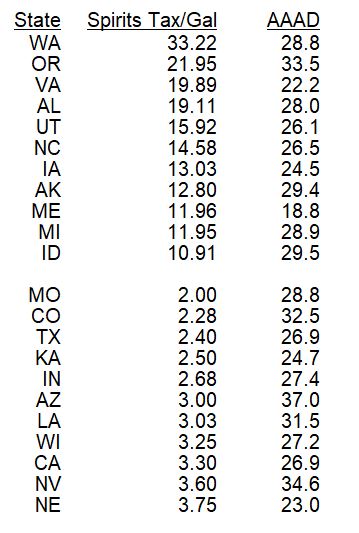
In recent years, public health advocates had very little success in changing specific alcohol policies in the US. Indeed, federal excise taxes were reduced in 2017. Availability and access mostly expanded. Earlier this year, most government entities deemed the alcohol beverage industry "essential" amid the coronavirus pandemic. Many regulations were relaxed in many states, especially regarding cocktails-to-go and delivery. But public health advocates are on the verge of a significant victory as the Dietary Guidelines Advisory Committee recently adopted a scientific report which recommends a major change in the Dietary Guidelines for Americans. The proposal reduces the recommended upper limit for men who drink to one per day, matching the upper limit for women and halving what had been the limit for men since 1990. Department of Agriculture and Health and Human Services officials will spend the rest of year drafting a final policy document, the 2020-2025 US Dietary Guidelines, slated for release by the end of 2020, though the process could stretch into 2021. Interested parties will continue to lobby for and against the recommended change.
Is Alcohol Deregulation a "Freedom" Issue?
In Mississippi, a free market think tank - the Mississippi Center for Public Policy - had an op-ed published in Jackson's Northside Sun, that acknowledged that 2020 was "not the year for alcohol freedom" in the state, given the pandemic. But, like Reason's Byard Linnekin (see above), Hunter Estes seeks broad deregulation in the control state, including: Sunday sales of alcohol wine sales in grocery stores, direct shipment of wine, expansion of liquor licenses, privatization of distribution, "craft brewery freedom" and regulatory reform. A host of bills were proposed to achieve these goals, many with broad public support, Estes claims, but almost all of them died. "Support for change in alcohol policy is not a political issue," Estes concluded, "but a freedom issue. The question at hand is whether state officials trust their constituents to make decisions related to personal responsibility for themselves…. Continued support for new policies demands a coming change to the status quo."
That's So Meta: Claims of Misinformation Pile Up in Public Health v Industry War of Words
"Contesting the robustness of our work by referring to a single sentence is misleading." Thus, we choose to begin an article covering claims of misrepresentation in responses to claims of misrepresentation in responses to claims of misrepresentation in a "systematic" study of language used to described scientifically-unconfirmed complexities and uncertainties. We do hope you're already a little confused and more than a little concerned. But before we attempt to clear things up, a little quiz. The following 10 excerpts were written by either (A) a government body/ government-funded researcher or (B) a researcher/leader at an organization funded (at least in part) by one or more alcohol industry members. Can you tell who wrote what?
In perhaps another spin on "never let a crisis go to waste," California Alcohol Policy Alliance (CAPA), is taking a cue from the resurgence of COVID-19 in that state to turn up the heat on Gov Gavin Newsome for failing to "make public health and safety essential by instead making alcohol essential in the state." CAPA's 40+ community-based member organizations, from Alcohol Justice to treatment and youth groups held a virtual press conference on July 22 to tell the governor: "Communities Lose When the Booze is Loose." Easing regulations and relaxing enforcement on alcohol purchases "under the dubious guise of economic relief" and making alcohol "essential" during the pandemic led to increased consumption, CAPA claims, and indicates "serious failure" by the Governor and state agencies to address the "catastrophic annual alcohol-related harms that already plague the state." The groups single out home delivery "with ineffective age verification," cocktails to go, more sales in public places and "normalization of drinking during a public health emergency of massive proportions." The goal: public pressure to have the Governor "closely re-examine California's relationship with Big Alcohol," (even while most of the measures have been adopted to help Small Alcohol), and "rescind the ABC's COVID-19 regulatory rollbacks." Specifically, CAPA asked the Governor to:
- "Rescind all 'temporary' alcohol rules and regulation rollback"
- Create new "standard alcohol policy regulation" as part of a COVID-19 response
- Address the disproportionate alcohol harms suffered by low-income communities of color
- Raise alcohol taxes and earmark them for treatment/prevention
- "Retire" outdated/unused alcohol licenses
A study of nearly 20,000 adults over 9 years "suggested that low to moderate drinking was associated with better total cognitive function and better cognition domain results for word recall, mental status, and vocabulary among middle-aged or older men and women in the United States," the authors concluded. What's more, consumption of less than 8 drinks per week among women and less than 15 drinks/week among men (i.e. the current Dietary Guidelines, before any proposed revision) "was also associated with slower rates of cognitive decline in those domains." In other words, low to moderate drinkers consistently scored higher than "never drinkers" on a series of cognitive measures and showed less decline in those skills over the study period. Results were stronger for white participants than black participants. In fact, among white participants, heavy drinkers scored better than never drinkers in several measures. All in, the authors determined an "optimal dose of 10-14 drinks per week," for all participants, again right within the current Dietary Guidelines for Americans.
New Study Contradicts Notion that Off-Premise Alcohol Outlet Density Drives Drinking and/or Problems
It is bedrock gospel in the public health world: greater accessibility to alcohol − higher outlet density − is linked to higher drinking rates and higher rates of alcohol problems. Public health advocates constantly point to this being the truth, the whole truth and nothing but the truth. They have a CDC imprimatur/ claim that "high alcohol outlet density …is known to be a risk factor for excessive drinking" and a Community Preventive Services Task Report that recommends "limiting alcohol outlet density through the use of regulatory authority (e.g. licensing and zoning)" which CDC similarly claims is "based on strong scientific evidence of intervention effectiveness." (Our emphasis.)
Zero Tolerance in ZA and the Skies; South Africa to Adopt 0.0 BAC Limit; Airlines Ban Alcohol
It's not all about relaxation of alcohol rules in the current environment. South Africa (internet ID is ZA), one of the few nations that totally locked down the alcohol business, at least temporarily, during the pandemic, is on the road to adopting a 0.0 BAC limit for driving.
In addition to his comments in Drug and Alcohol Review regarding how consumptions trends may vary in the short- and long-term as a result of the pandemic (see May AII), veteran researcher Jürgen Rehm and some colleagues made an urgent plea for immediate research funds in the Journal of Studies of Alcohol and Drugs. As we suggested last month, COVID-19 has provided unique, vast and critical opportunities for alcohol consumption, harms and policy research, Dr. Rehm points out. "Rapid changes in the supply, demand, marketing, drinking contexts, and associated risks" and more need to be monitored, analyzed and evaluated to inform future policy and to get to what WHO calls a SAFER world, "free from alcohol-related harms." Rehm reminds that WHO's 2018 SAFER vision included Strengthening restrictions, Advancing drunk driving countermeasures, Facilitating interventions/treatment, Enforcing alcohol ad/marketing/ sponsorship bans and Raising alcohol prices.
Public health advocates have made "raise alcohol excise taxes" a rallying cry for decades (see above). The World Health Organization considers it a "best buy" among alcohol policy options. Consumers, most government officials and policymakers, not to mention the industry, tend to take a more skeptical view of taxes. Public health advocates firmly believe that higher taxes, by driving prices up, will inevitably reduce problem drinking and per capita consumption levels. Would they? Of course, drastic price changes would impact sales of any product. But alcohol consumers tend to be pretty loyal to their liquids, especially heavy drinkers, as recent events have proved once again. And even public health advocates are smart enough not to recommend radical increases. Two recent reports raise this question again. The Tax Foundation published a map of state-by-state spirits taxes, citing the Distilled Spirits Council as the source. And the National Institute of Health just reported state-by-state beer, wine and spirits consumption per capita (age 14+) for 2018. Do states with higher levels of taxes necessarily have lower per capita spirits consumption? Are low taxes associated with higher consumption rates? Spoiler alert: not really.